Oil, Grit, and Gains: 6 Ancient Turkish Wrestling Principles That Will Transform Your Leg Day Forever
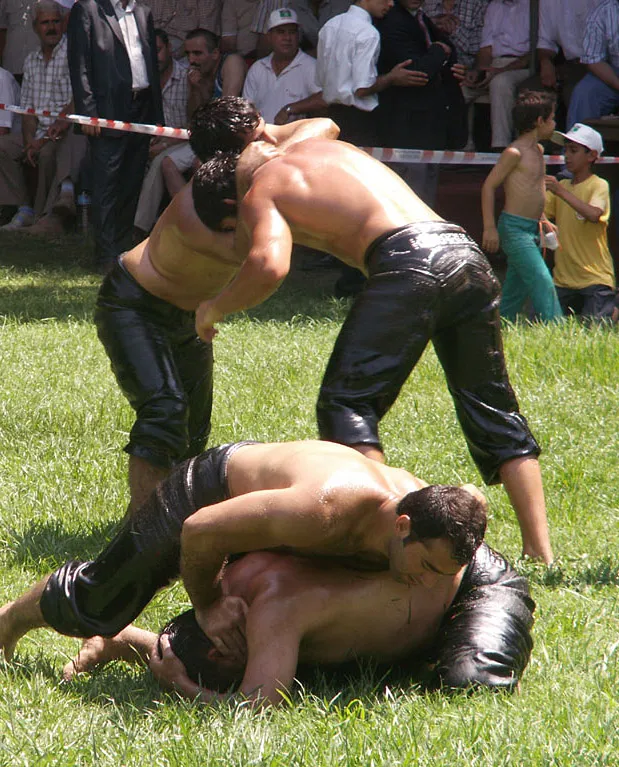
Photo: User:Math34, CC0, via Wikimedia Commons
Why Ancient Athletes Had Legs We're Still Trying to Build
Let's be honest — leg day is where a lot of gym-goers quietly phone it in. Big upper bodies, underdeveloped quads, calves that look like an afterthought. It's practically a meme at this point. But here's the thing: there's a tradition of athletic training that's been producing devastating lower body development for over 650 years, and most American fitness enthusiasts have never heard of it.
Yağlı güreş — Turkish oil wrestling — dates back to the Ottoman era and remains an active competitive sport today, with the Kırkpınar tournament in Edirne being the longest-running sporting event in recorded history. The athletes who compete in it — called pehlivanlar — develop lower body strength, stability, and muscularity through a system of training that has no direct equivalent in Western strength sports.
Contemporary bodybuilders and strength coaches have started paying attention. And what they're finding is that the principles behind traditional Turkish wrestling training line up surprisingly well with modern sports science on hypertrophy and injury prevention.
Here are six of those principles — and how to apply them to your leg training right now.
1. The Stance Is Everything: Train Your Hip Hinge Like Your Life Depends on It
The foundational movement in Yağlı güreş is a deep, wide-stance athletic position that demands serious hip mobility and posterior chain engagement. Wrestlers spend enormous amounts of training time just moving in and out of this position — loading the hips, maintaining spinal integrity, and building the kind of hip hinge strength that a standard gym program almost never develops.
The application: Before any leg session, spend 10 minutes on loaded hip hinge work. Romanian deadlifts, good mornings, and kettlebell swings aren't just warm-ups — in the Turkish wrestling tradition, this kind of movement IS the training. Build it into your program as a primary pattern, not an accessory.
The science: Research on posterior chain activation consistently shows that athletes with strong, well-conditioned hip hinge patterns experience fewer knee injuries and develop more complete quadriceps activation during squatting movements. The hinge teaches the body how to load correctly.
2. Isometric Holds Build the Strength Nobody Else Has
Wrestlers spend significant time in static holds — gripping an opponent, holding a position against resistance, maintaining a low stance under pressure. This develops isometric strength that dynamic training alone simply doesn't build. The muscles learn to produce force without movement, which creates a kind of deep, dense muscular development that looks different from standard gym training.
The application: Add isometric pause work to your squats and lunges. A three-second pause at the bottom of a squat, a five-second hold in a split squat — these aren't gimmicks. They're targeted stress that builds the kind of strength that holds up under load. Wall sits, though unglamorous, are also legitimately effective for quad development when held for extended periods.
The science: Isometric training has been shown in multiple studies to produce significant strength gains across the full range of motion, not just at the specific joint angle trained. It also tends to be lower-impact on connective tissue, making it valuable for injury prevention.
3. Single-Leg Strength Is Non-Negotiable
In wrestling, you're constantly on one leg — shifting weight, driving off a single foot, recovering balance under pressure. The training reflects this. Pehlivanlar develop extraordinary unilateral leg strength that bilateral training alone can't replicate. Imbalances get exposed and fixed. Stability becomes a foundation, not a finishing touch.
The application: Bulgarian split squats, single-leg Romanian deadlifts, step-ups with a pause at the top — these should occupy at least 30-40% of your leg training volume. If one side is noticeably weaker, address it first before loading bilateral movements. The Turkish wrestling approach treats unilateral weakness as a structural problem, not a cosmetic one.
The science: Unilateral training has been shown to activate stabilizing musculature — glutes, hip abductors, deep core — at significantly higher rates than bilateral movements. This translates to better overall leg development and dramatically reduced injury risk.
4. Carry Heavy Things for Long Distances
Historical training for pehlivanlar included loaded carries — moving heavy objects over distance as a foundational conditioning tool. This builds the kind of full-body, leg-dominant functional strength that transfers to virtually everything. Farmers carries, sandbag carries, and yoke walks are the modern equivalent.
The application: Finish your leg sessions with two or three sets of heavy farmer's carries — 60 to 100 feet per set. The loading on your quads, glutes, and calves during a heavy carry is substantial, and the grip and core demand adds conditioning that keeps your sessions efficient. Sandbag bear hugs are an even closer approximation of the traditional training.
The science: Loaded carries have been validated by strength and conditioning researchers as one of the most efficient tools for developing integrated lower body strength and hypertrophy, particularly in the posterior chain and stabilizing musculature.
5. Ground-Based Movement Develops Joints, Not Just Muscles
Pehlivanlar spend time on the ground — not as a failure state, but as a training position. Getting up from the ground under load, moving laterally in a low position, transitioning between stances — all of this builds joint integrity in a way that machine-based training fundamentally cannot.
The application: Incorporate get-ups, lateral shuffles in a low squat position, and ground-to-standing transitions under light load into your warm-up or accessory work. Goblet squat holds with lateral movement are a great starting point. These aren't just mobility drills — they're joint conditioning that keeps your knees and hips healthy through heavy training cycles.
The science: Joint health research consistently points to the importance of training through varied planes of motion and positions. Joints that only ever experience one plane of loading become vulnerable to stress in other directions — exactly the pattern that causes overuse injuries in dedicated gym athletes.
6. Recovery Is Part of the Method, Not an Afterthought
Traditional pehlivan culture treats recovery as a skill. Cold water immersion, massage with olive oil (which has legitimate anti-inflammatory properties), structured rest periods, and adequate sleep aren't luxuries — they're part of the system. The wrestlers who last longest aren't the ones who train hardest. They're the ones who recover best.
The application: Build structured deload weeks into your programming every four to six weeks. Use contrast showers, prioritize sleep aggressively during heavy training blocks, and don't underestimate the value of light movement on rest days — walking, swimming, mobility work. Your legs grow when you recover, not when you're in the gym.
The science: Muscle protein synthesis peaks in the 24-48 hours following training and requires adequate rest, nutrition, and reduced stress to complete effectively. Athletes who consistently under-recover produce less muscle over time, regardless of training volume.
Putting It Together
You don't need to slather yourself in olive oil and head to Edirne to benefit from any of this (though honestly, Kırkpınar is worth a trip if you ever get the chance). These principles are practical, grounded in both tradition and science, and most of them can be plugged into your existing programming without a complete overhaul.
The Turkish wrestling tradition built some of the most formidable athletes in human history using tools that were simple, effective, and deeply understood. That's not a bad blueprint to borrow from.
At Bodybuilding Türkiye, this is exactly the kind of knowledge we're here to surface — the iron-rooted traditions that modern training has overlooked, brought to the gym floor where they belong.